 Vanessa Wood
Scroll through Find A Grave long enough and you’ll notice a pattern: photo after photo of single gravestones, tightly cropped, isolated from the background and lacking context. A grave stone alone fails to show the family connections that genealogists look for in cemeteries.
The Trend
Burial photography on sites like Find A Grave overwhelmingly favors the single close-up. But these snapshots strip away everything a gravestone doesn’t say for itself: who’s resting to the left and right, what section of the cemetery this is, whether this grave belongs to a cluster of related families, colleagues, or — as it turns out — people who shared far more than a burial ground in common.
Dr. James McCune Smith’s Grave
Dr. James McCune Smith is a good example of exactly what’s at stake (I first wrote about Dr. Smith and mapped his family’s burials [see post] — this post picks up where that one left off).
Smith was the first African American to earn a medical degree — he trained at the University of Glasgow after being barred from medical schools in the United States. He built a career in New York City as a physician, apothecary, and one of the era’s most articulate abolitionist voices, writing and organizing alongside Frederick Douglass and other leading Black intellectuals of the 19th century. He died on November 17, 1865 — just nineteen days before the Thirteenth Amendment was ratified.
He was buried at Cypress Hills Cemetery in Brooklyn. And for well over a century, his grave sat unmarked.
In 2010 descendants placed a gravestone marking Dr. Smith’s burial — they placed the memorial after they found their connection to Dr. Smith in a family Bible and through detailed research. The dedication of that gravestone was itself a genealogical statement, decades after the fact.
Here’s where the cropped-photo problem comes back in. If you look up Smith’s memorial today, you’ll get a photo of his stone — respectful, legible, alone in the frame. What that single image doesn’t show is where he’s actually resting.

One gravestone misses the sheer number of family members buried around Dr. Smith. Cemetery records and a site visit were needed to determine the full context of the burials. His mother Lavina, a self-emancipated woman born in South Carolina in the eighteenth century rests in the plot. Several of Dr. Smith’s children are buried there. Although Dr. Smith was not the first burial, he was honored by burial at the front and center of the plot. Looking beyond Dr. Smith’s plot, it can be seen that he is buried near other prominent men of his era. Cemetery markers have been placed for Dr. Smith (4) and nearby Rev. Charles Ray (4b) and Charlotte Ray (4c); and Philip White (4e).
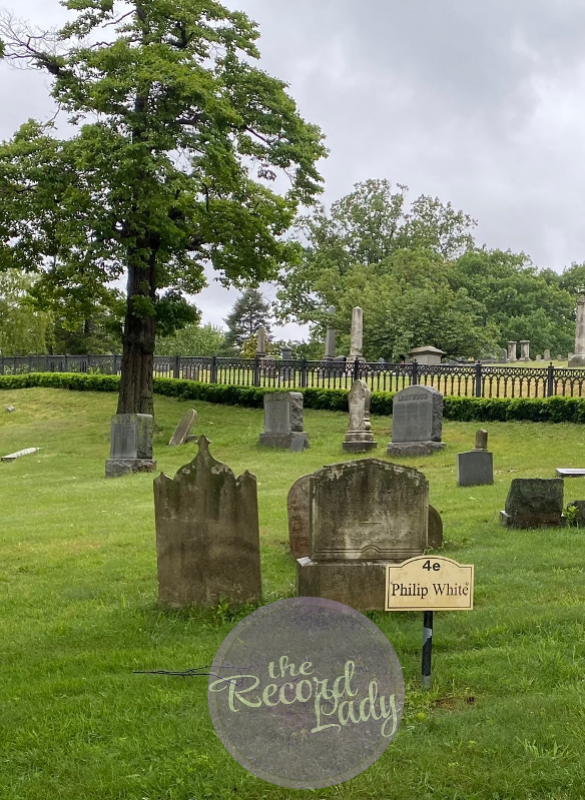
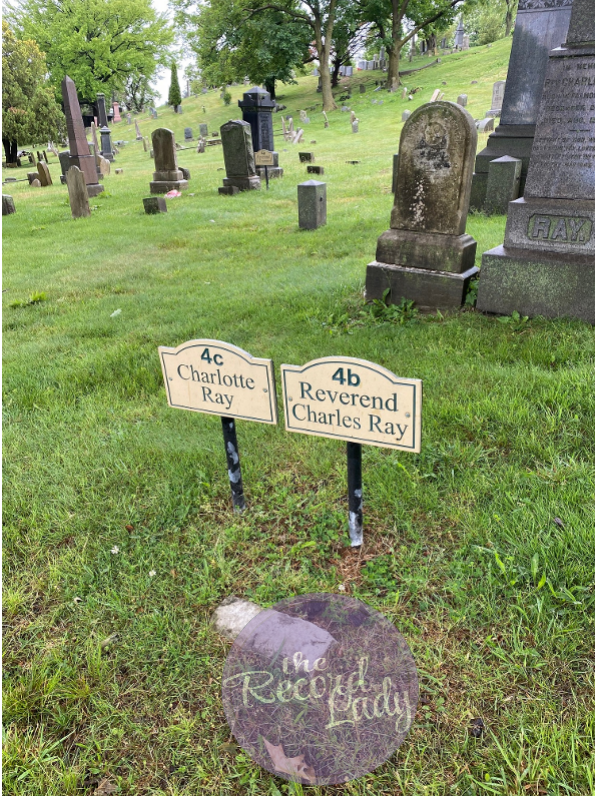
That’s not a coincidence, and it’s not incidental. It’s a cluster — the kind of pattern that FAN research (Family, Associates, Neighbors) depends on to answer questions no single record ever could: Who chose to be buried together, and why? Did these families know each other in life the way their plots suggest? Was the selection of Cypress Hills a trend within a community to favor burials in its idyllic setting? A cropped photo of one stone can’t ask that question, let alone answer it — you need the surrounding graves in view to even notice it’s worth asking
Why This Matters Beyond One Grave
Multiply this by every cemetery, every family, every genealogist who’s hit a brick wall. This obstacle is usually a time frame where vital records are not available and the only image available is one stone in isolation. Burial clusters can reveal:
- Sequence of deaths — which family members died close together, which might point to an epidemic, an accident, or simply old age catching up with a generation at once
- Family and community groupings — who’s buried near whom, which can confirm or challenge assumed relationships
- Social and associational ties — neighbors, business partners, fellow church or lodge members buried together, the same kind of pattern visible at Cypress Hills
None of that survives a tightly cropped, single-stone photo. It survives only if someone thought to capture the wider picture.
What To Do Differently
If you’re photographing a cemetery — for your own research, or for a site like Find A Grave — a few extra steps make an enormous difference to the next researcher who comes along:
- Take a wider shot. Step back and capture several graves in sequence before you zoom in on the one you came for.
- Note the plot or section number if the cemetery has these. Many modern cemeteries have streets named within their grounds and these can be helpful to identify locations.
- Photograph adjacent stones, even ones that seem unrelated — you don’t know yet what they’ll turn out to mean.
- Record the GPS coordinates or a landmark reference, especially in older or less-mapped cemeteries. The coordinates can be found on smartphones and Find a Grave has a field for them.
- Ask the cemetery office whether burial order records or plot maps exist — some, like Cypress Hills, maintain detailed records of notable burials by section.
A single tombstone tells you someone lived and died. The graves around it can tell you who they were.
Photographs of Cypress Hills were taken by Vanessa Wood in 2021.