 Vanessa Wood
Hazel B. Green, interviewed Ben C. Williams in 1937 for the Federal Writers Project, a Depression-era Works Project Administration (WPA) project.1 I compared Ben’s interview with documentary evidence in an article published by the Illinois State Genealogical Society.2 The article is now available in Kinship Papers: Volume 1.Ben was quite elderly when he gave his account to the WPA interviewer. He may have had memory issues. I learned two new things from his interview that were interesting pieces of American history: Unorganized Territory and a Indian Wars pension.
Unorganized Territory
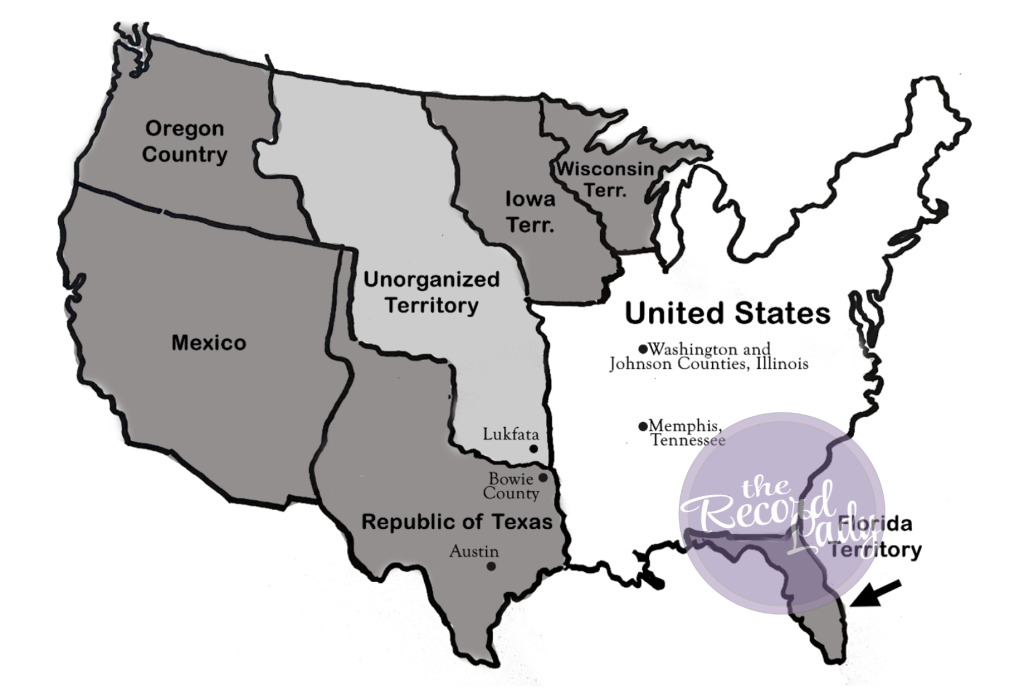
Ben’s account of his family’s movement west from Illinois included entering an area that would have been Unorganized Territory (see Map below). This was a place during a short period of the mid-1800s had not given a territorial name. The southern-most part included part of present-day Oklahoma and it bordered the The Republic of Texas. Unorganized meant there were no governments established so there were no record keeping. It would be another twenty years before the Pony Express would run mail from Missouri westward. More than twenty years before the first transcontinental railroad. The land lay beyond the terminus of the National Road in Vandalia, Illinois and beyond the commerce hubs along mid-west rivers, such as the Mississippi and Missouri.
Map Showing Unorganized Territory ca. 18403
Indian Wars Pension
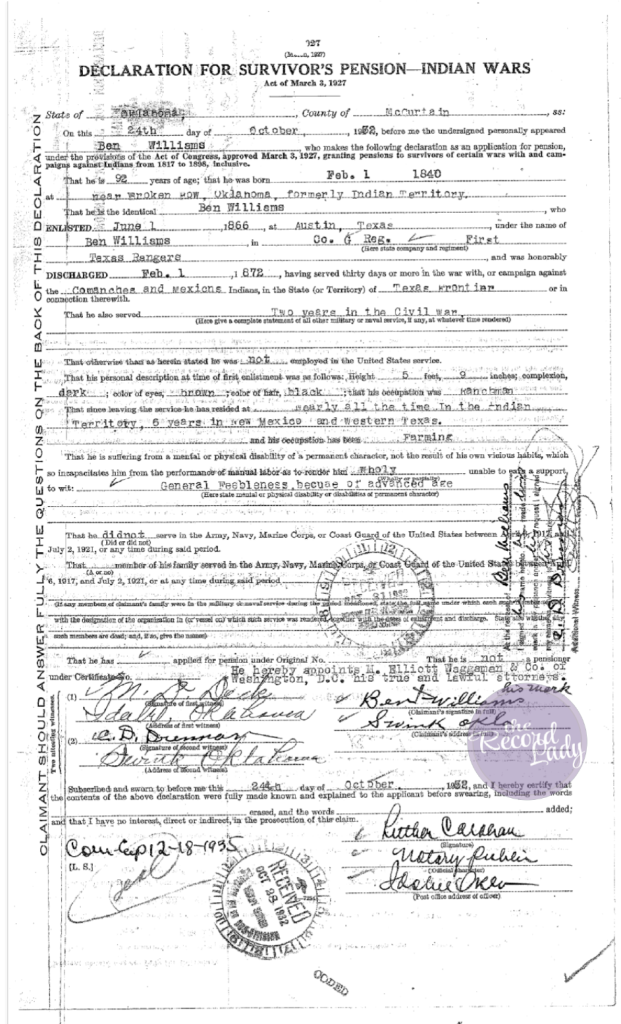
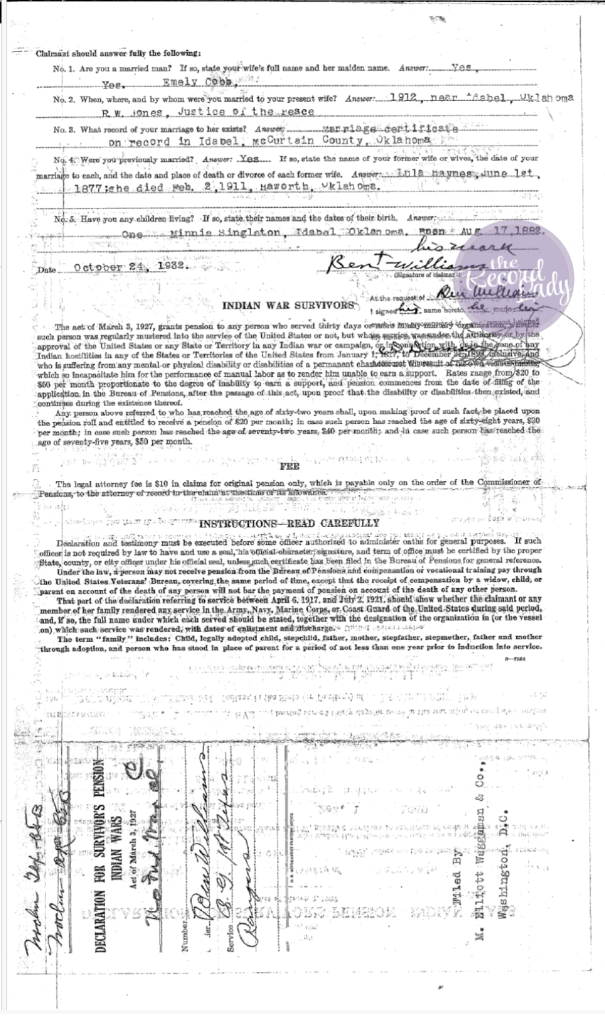
I have seen many Revolutionary War and Civil War pensions. Ben C. Williams applied for a pension for service in the Indian Wars on the “Texas Frontier.”4 Ben’s declaration shows he enlisted in 1866 and served in the Texas Rangers. During his 1937 interview he discussed his Civil War service. He said he was captured and carried off to Memphis, Tennessee. He was release upon taking and “Oath of Allegiance.” That is an interesting statement because the Union officials required Confederates to take an oath. An article on the National Archives (NARA) website states what southern researchers at times encounter–Confederates did not qualify for Union Army pensions.5 The author explains that soldiers who joined Confederate forces and later served in any form of the U.S. military would find they could not collect their Union pensions because of their prior Confederate affiliations. Ben’s answer on his declaration (see Sheet 1 below) skirted the issue by stating he served “Two years in the Civil war” without mentioning on which side he served.
[sheet 1]
Say Thank You…Click Buy Me A Coffee to support my genealogical research.
[sheet 2]
FEATURED IMAGE: “Outline of Texas”, CoPilot AI, illustration, 2026
- Hazel B. Greene, interviewer, Interview with Ben C. Williams, U. S. Works Progress Administration (WPA), Federal Writers Project, archival order 98, interview ID 9730, 12 July 1937; images of typed transcription, Oklahoma University (https://digital.libraries.ou.edu/cdm/singleitem/collection/indianpp/id/5866/rec/28) > Western History Collections-Indian Pioneer Papers > University of Oklahoma Libraries Western History Collections > 5867.pdf.
- Vanessa Wood, “The Williams Family Who Disappeared from Illinois into Unorganized Territory,” Illinois State Genealogical Society, The Quarterly 55 (Spring 2023), 20-28.
- Vanessa Wood, U.S. Map Showing unorganized territory, 1840, with aid from “American Studies,” University of Virginia (http://xroads.virginia.edu/~MAP/TERRITORY/1840MAP.html)>Cultural Maps>American Historical Atlas>Territorial Expansion of the United States 1775–1920>1840. Also, Henry A. Burr, creator, Disturnell’s New Map of The United States and Canada : Showing All the Canals, Rail Roads, Telegraph Lines and Principal Stage Routes, (New York: J. Disturnell, 1850), map; image, Library of Congress (https://www.loc.gov/item/2012593337/) . And, G. P. Strum, Indian Territory, (Washington, D.C.: Government Printing Office, 1883), map; image, Oklahoma State Library (https://dc.library.okstate.edu/digital/collection/OKMaps/id/4418).
- Declaration for Survivor’s Pension, “Indian War Pension Files, 1892–1926,” no. 1727192, file C-2620344, Ben Williams, p. 2, 24 Oct. 1932; National Archives and Records Administration (NARA), Federal Pension Applications.
- Claire Prechtel-Kluskens, “‘A Reasonable Degree of Promptitude’ Civil War Pension Application Processing, 1861–1885,” Prologue Magazine (Spring 2010), National Archives (https://www.archives.gov/publications/prologue/2010/spring/civilwarpension.html).