 Vanessa Wood
On the night of 24–25 February 1942, three of my relatives were working for the war effort at Douglas Aircraft Company in Southern California: my grandfather, a second cousin, and my dad. Dad was a college student working part time as a messenger. He left Douglas when he was drafted into the Army Air Forces, and some forty years later he found himself working there again.
Less than three months after Pearl Harbor, Southern California was on edge. Two nights earlier, a Japanese submarine had shelled an oil field near Santa Barbara. Then, at 2:23 a.m. on 25 February, air raid sirens sounded across the Los Angeles area. Searchlights swept the sky, and anti-aircraft guns fired for about an hour at planes many people were sure they saw. When daylight came, no bombs had fallen and no enemy aircraft were found. The night became known as the Battle of Los Angeles.
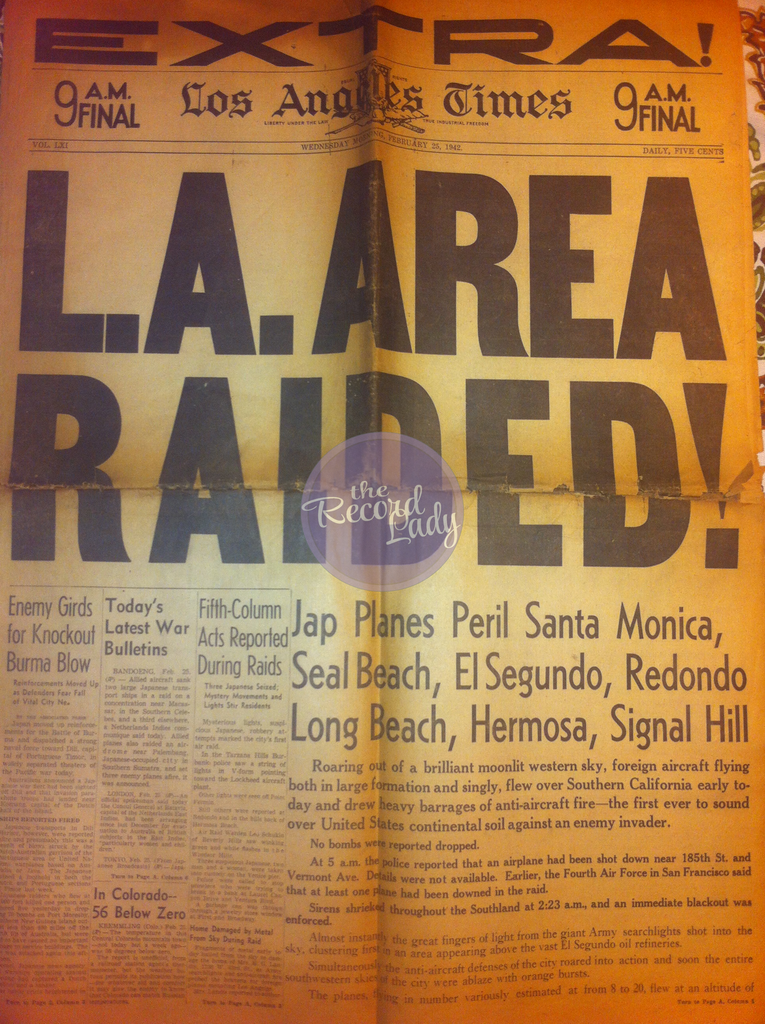
Dad saved two documents from that day, and together they tell the story better than I can. The Los Angeles Times rushed out a 9 a.m. extra declaring the area had been raided, with enemy planes reported over Santa Monica, El Segundo, Long Beach, and other coastal towns.
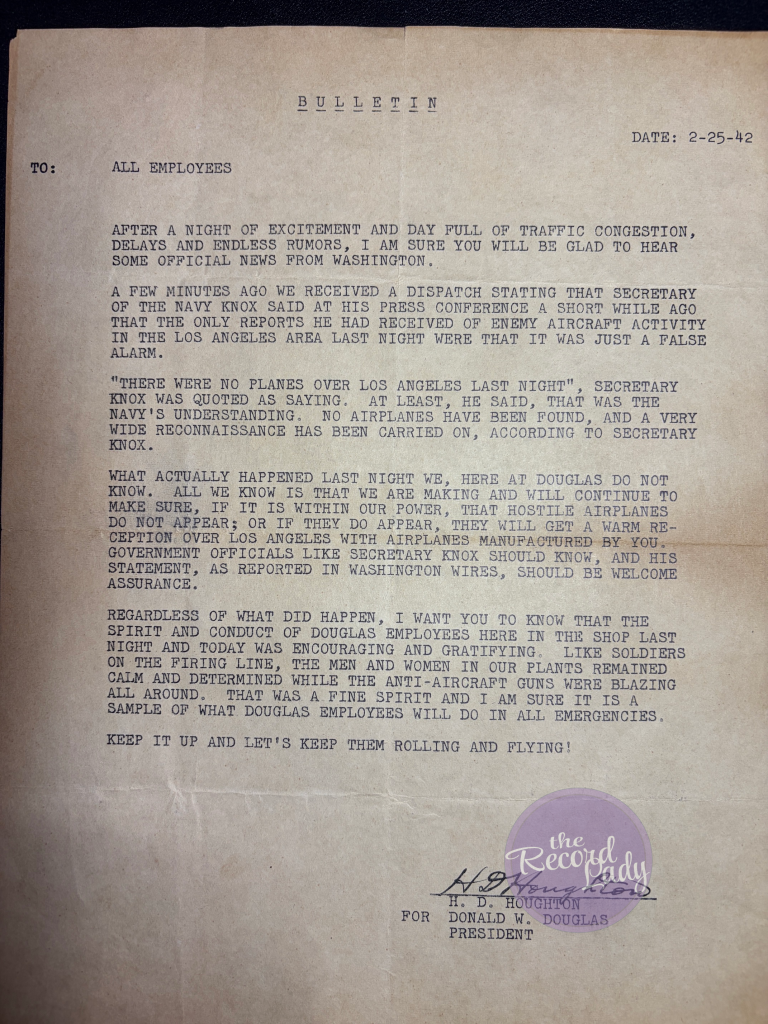
The same day, Douglas sent a bulletin to all employees. It relayed word that Secretary of the Navy Frank Knox had called the whole thing a false alarm. The company admitted it didn’t know what had happened, but praised its workers for staying calm while the guns blazed around the plants.
Same day, two very different accounts. That’s why I love finding papers like these in a family collection. A newspaper shows what the public was told. A document like the Douglas bulletin shows what the people inside the story were hearing.
What actually happened is still debated. That same week, the Army insisted enemy planes had been overhead, while the Navy called it a false alarm. After the war, Japan said it had sent no aircraft over Los Angeles that night, and many historians now blame war nerves, perhaps set off by a stray weather balloon. Whatever it was, the barrage wasn’t harmless. Falling shell fragments damaged homes, and several deaths were blamed on the night’s confusion. If you’re curious, YouTube has a number of videos with photos and footage from that night, though some wander into UFO theories.
World War II would eventually take Dad much farther from home. More about that in my next post.
FEATURED IMAGE: The new B-17E Flying Fortress, as pictured in early 1942. U.S. Army Air Forces, Air Forces News Letter, Jan.–Dec. 1942, “The New B-17E, Latest Flying Fortress,” p. 36; digital images, Internet Archive (https://archive.org/details/AirForcesNewsLetter-nsia : accessed 27 Oct 2026), image 43 of 379.