
 Vanessa Wood
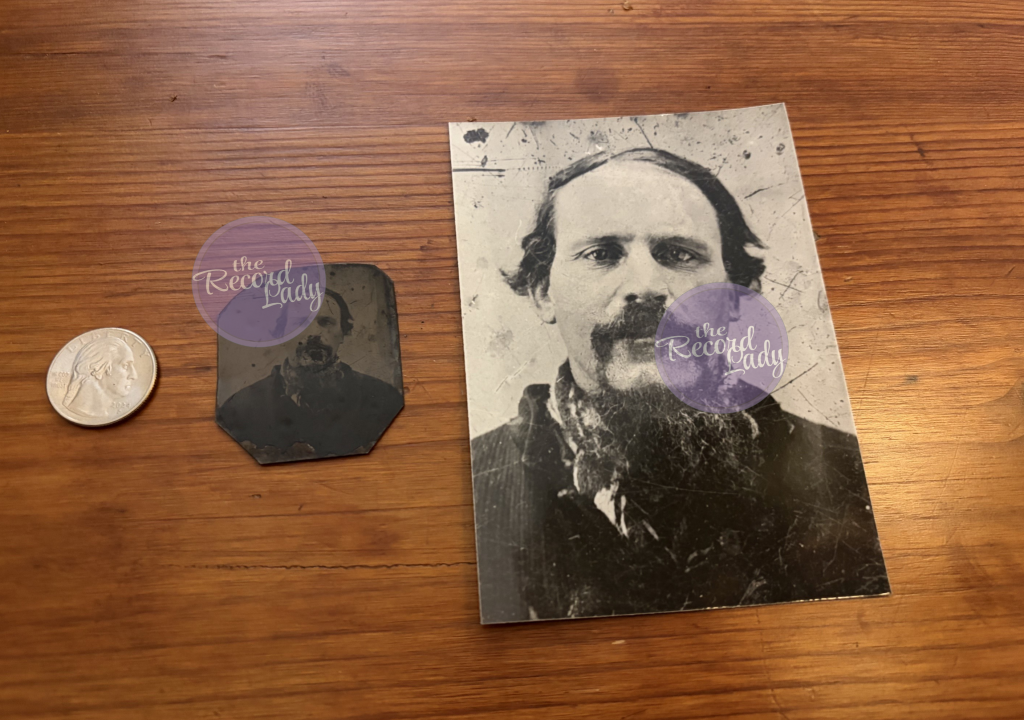
Back in the twentieth century my beloved aunt gave me a tintype of my great-great grandfather Wesley Cunningham. In the years before Photoshop, the only choice for reproduction was to take the tintype to a professional restoration service to have it enlarged and printed on paper. I posted it on FindAGrave.com and they have been “taken” off of Find A Grave and propagated across numerous family trees.1 Recently I saw on Ancestry.com the photograph has been colorized and posted to several Ancestry family trees. What’s interesting is that someone has credited me with the photo (as they should since I’m the owner), but at no time did I give them permission to publish the photograph nor did I give permission to colorize the photograph before publication. If you’ve read my article titled “Do You Take Photographs from eBay for The Sake of Genealogy?” you’ll already know I have strong opinions about the use of photographs.
Figure 1: Wesley Cunningham Original Tintype and Restored Print2
Historians’ Views on Colorization
You don’t have to look too far to find historians’ opinions about colorization of photographs. Bridget Keown, a lecturer in the Gender, Sexuality, and Women’s Studies program at the University of Pittsburgh authored an article titled “The Problem With Colorizing Historic Photographs.” In the context of examining manipulation of historical photographs she pointed the adverse effects of manipulation,
It implies that we wish the world of the past to be rendered in our own image, rather than doing the work to understand the story and the humanity of a subject who is somehow unclear to us.” 3
Keown’s opinion that manipulated photographs change how we view the subject reminds me of a recent experience. I tried MyHeritage’s Live MemoryTM service. This is the program that animates a still photograph. I uploaded an unsmiling, sepia tone portrait from the 1920s. The result was unnatural and unnerving. The previously dour subject cracked a grin and then opened their mouth to show a creepy toothy smile. The subject looked inconsistent with an era when toothy smiles were not the norm. The subject looked sinister and this animation might make future a viewer make unfounded assumptions about the subject–such as, they were happy or had good dental care.
Media historian and archivist Luke McKernan says,
Colourisation does not bring us closer to the past; it increases the gap between now and then.”4
If colorized photographs distort history and put distance between our time and the subject’s time…then what’s the purpose of colorizing?
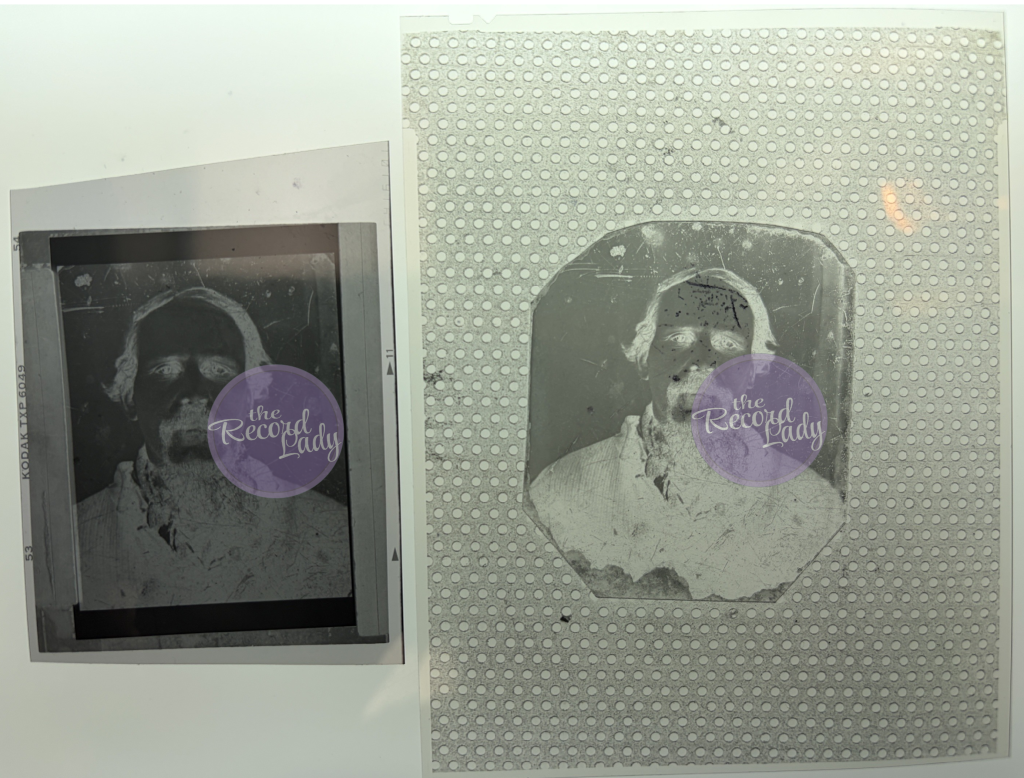
Figure 2: Wesley Cunningham Negatives5
Colorization and Genealogy Standards
If historians say colorization is unethical, how does it measure up to Genealogical Standards? Genealogical Standards suggest colorization does not meet standards, especially the following Standards.
Standard 1 – Scope6
Genealogists use citations to identify the sources of all substantive information and images they gather, use, or plan to gather or use…”
I wrote about AI generated images two years ago: AI for Genealogy Starts and Ends with Full Disclosure in Citations. If you’re going to use a colorized image you have to say what it is in a source citation.
Standard 63 – Honesty7
All genealogical writings present evidence objectively and without bias or preconceptions. They do not distort, mask, overplay, or underplay evidence.”
If using a colorized image in a family tree, a blog post, a written article or report, then you have to weigh honesty. It depends what tool is used to colorize a photo because some tools make their own decisions of how to apply color. If someone can make color suggestions or requests they may skew photographic evidence. For instance, if you think someone was a redhead and ask an AI tool to change a black and white photo to a redhead.
Ownership, Use, and Genealogy Standards
Standard 62 – Integrity and Ownership8
Genealogical writers observe all ethical and legal standards that safeguard against plagiarism and copyright infringement.”
Find A Grave‘s position on photo use is stated on their website,
Photos on Find a Grave are submitted by contributors. Contact the contributor directly to request permission to use the photo. Their Profile name is found under the photo submitted.”9
Judy Russell, The Legal Genealogist, has written about usage of photographs from Find A Grave saying,
When we use Find A Grave content, we need to again avoid violating anyone else’s copyright and understand that we’ve agreed to use it only in our research projects.”10
End Thoughts on Colorization and Usage
I know some will think I’m a party pooper putting a damper on the fun of bringing photographs to life with AI and sharing them with others. I agree with historians that see altered photographs as distorting our view of the past. As a professional genealogist I recommend following Genealogical Standards. I use AI generated illustrations on my website and label cite their source them in footnotes. Through other professional pursuits I’ve been a member of the Graphic Artists Guild and the Society of Children’s Book Writers and Illustrators, organizations that took firm stances on plagiarism and copyright protection. The best way to resolve permission is to ask for permission, and recognize only a positive reply constitutes permission.
FEATURED IMAGE: Illustration of old fashioned camera on a tripod with a sign saying PICTURE DAY in the background, CoPilot AI, 2026.
- Find A Grave, database with images (https://www.findagrave.com/memorial/48231898/wesley-cunningham), “Wesley Cunningham” (1835-1896) memorial and gravestone photograph created by “Searchers of our Past”; citing Markley Cemetery, Markley, Young County, Texas.
- Vanessa Wood, “Wesley Cunningham, Tintype, ca. 1870 (left); and Wesley Cunningham Print Reproduction, ca. 1990 (right)”, JPG photograph, 14 June 2026, author’s collection.
- Bridget Keown, “The Problem With Colorizing Historic Photographs,” 2021, Lady Science (https://www.ladyscience.com/), pargraph 9.
- “Colouring The Past,” Luke McKernan (https://lukemckernan.com/2018/01/25/colouring-the-past/), paragraph 6.
- Vanessa Wood, “Wesley Cunningham Negative of Restored Photographs (left); and Wesley Cunningham Negative of Tintype (right)”, JPG photograph, 14 June 2026, author’s collection. The photograph was taken with use of a lightbox.
- Board for Certification for Genealogists, Genealogy Standards, 2nd Edition (Nashville, Tennessee: Ancestry.com, 2019), 5.
- Board for Certification for Genealogists, Genealogy Standards, 2nd Ed. (Nashville, Tenn.: Ancestry.com, 2019), 36.
- Board for Certification for Genealogists, Genealogy Standards, 2nd Ed. (Nashville, Tenn.: Ancestry.com, 2019), 36.
- “Questions About Photos,” Find A Grave (https://support.findagrave.com/s/article/Questions-about-Photos : accessed 14 June 2026).
- Judy G. Russell, “Find A Grave terms 2014 style,” 20 August 2014, The Legal Genealogist (https://www.legalgenealogist.com/2014/08/20/find-a-grave-terms-2014-style/).


